CBT for Social Anxiety
Effective Help for Social Anxiety
If you dread parties, avoid speaking up in meetings, rehearse conversations in your head for days beforehand, or feel your heart race just thinking about being watched or judged – you're not alone, and there's a proven way forward.
Left unaddressed, social anxiety can shrink your world – limiting careers, friendships, and everyday experiences. The good news: it responds very well to a specific, well-researched form of treatment.
What Is Social Anxiety Disorder?
Social anxiety disorder is more than shyness. It’s a persistent fear that something about how you come across – a shaky voice, an awkward pause, a blush – will lead others to see you as embarrassing, boring, or unlikeable.
If you live with social anxiety, you’ll know that lots of social situations can cause fear, whether that’s a work meeting, a party, or a quick phone call. So you either avoid it, or do your best to get through it, often at real emotional cost. And even though part of you may know the fear is bigger than the actual risk, that doesn’t make it any easier to shake. Over time, it can start to affect your work, your relationships, your studies – all the ordinary parts of life.

Common signs of social Anxiety
Avoidance
Avoiding gatherings, presentations, phone calls, or new people.
Physical symptoms
Blushing, sweating, trembling, dry mouth or a racing heart.
Behaviours
Things like rehearsing what to say, difficulty with eye contact or not speaking in groups.
Anticipatory anxiety
Intense anxiety before social events, sometimes for days or weeks.
Replaying the moment
Replaying conversations afterward, searching for mistakes.
Fear of negative judgement
Worrying that others will see you as awkward, boring, or stupid.
What keeps social anxiety going?
If you’ve wondered why social anxiety doesn’t seem to fade even when things generally go fine, there’s a good explanation. According to the cognitive model developed by psychologist David M. Clark, people with social anxiety get caught in a self-focused spotlight that actually makes interactions harder, not easier. Here’s how it tends to unfold:
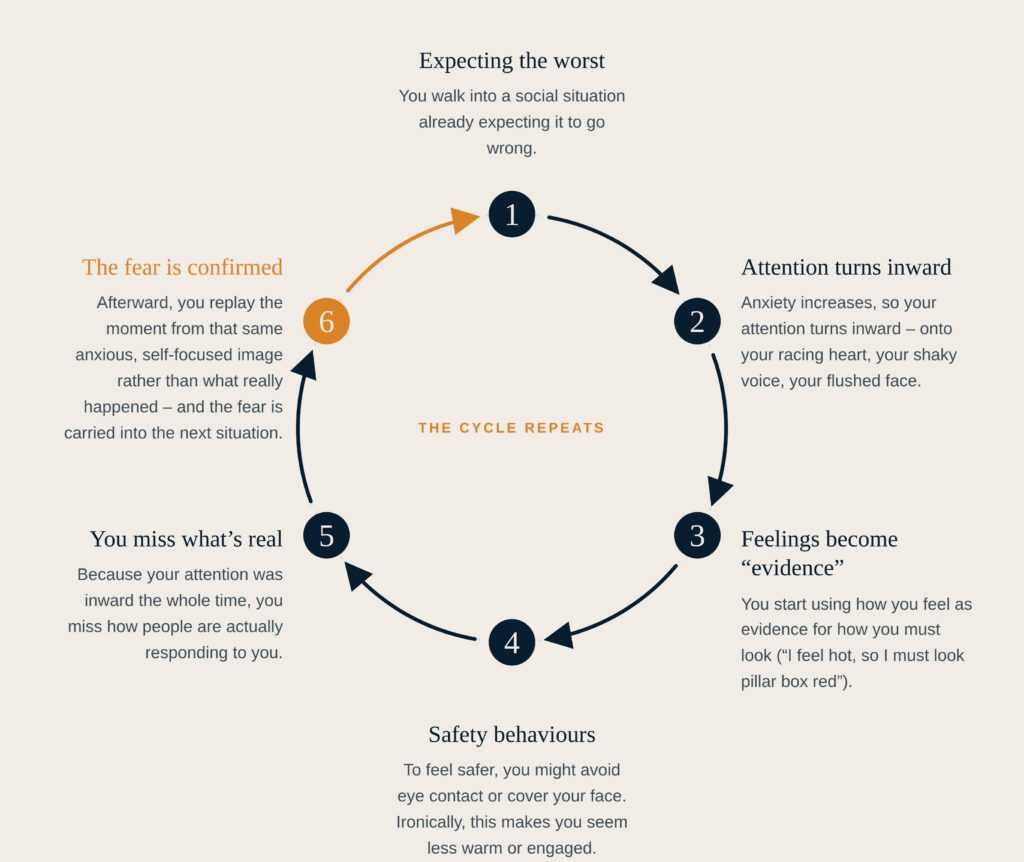
How CBT can help
Sessions follow a clear, collaborative structure built directly around this model. Core elements typically include:
Building your personal picture – Mapping your own cycle makes the problem easier to understand and manage.
Shifting attention outward – Many people are surprised to discover how much of their “evidence” for being judged was really just internal sensation, not anything anyone else could see.
Changing habits – Letting go of things like avoiding eye contact, rehearsing sentences in your head, gripping a drink tightly, or over-preparing what to say.
Getting real feedback – Honest, direct feedback on how you come across socially.
Testing out fears – Designing small experiments to get convincing, first-hand evidence.
Working on worry and rumination – Interrupting worry before events, and reducing the tendency to pick apart your performance afterwards.
Gradually facing feared situations – With your new skills in place, re-entering situations you've been avoiding, starting with more manageable ones and building up.

What to expect
Treatment follows a clear, collaborative process from the very first session. You can expect therapy to be:
- Structured – each session builds systematically on the last
- Experience-based – beliefs are tested through direct experience and evidence, not just conversation
- Time-limited – many people complete treatment within 12 to 20 sessions
Does It Really Work?
Yes. This is considered one of the most rigorously evidenced psychological treatments available for social anxiety disorder and is recommended in national guidelines.
Who you'd be working with
You Don't Have To Navigate This Alone
Whether social anxiety is a problem at work, in relationships, or in everyday interactions, it doesn't have to define your life. Taking the first step is often the hardest part, particularly given talking to someone one-to-one might be exactly the sort of situation that you would normally avoid.
I've been helping people work through this since 2010 and training other therapists to do the same since 2015, so you're in capable hands.
BABCP Accredited Cognitive Behavioural Therapist
I'm Lauren Coombs, a BABCP-accredited expert in Cognitive Behavioural Therapy based in Wilmslow, Cheshire. I’m also a Senior Lecturer in Psychology at the University of Chester where I teach and supervise future therapists.
I offer face-to-face sessions in Wilmslow and online sessions for clients across the UK. Sessions are available on Mondays, Tuesdays and Thursdays including early mornings and evenings.