Breaking the cycle of doubt and ritual
OCD and ERP Treatment
If intrusive thoughts, constant doubt, or exhausting rituals are running your day, you’re not alone. Checking, reassurance seeking and avoidance bring short-term relief but keep OCD going. ERP is the best-supported therapy for OCD. Facing fears can sound daunting, but we work step by step, at a pace we agree on together.

What OCD actually is
OCD is often reduced to a joke about tidiness. In reality, it's a distressing problem which has two parts:
Obsessions - unwanted, repetitive thoughts, images, or urges that cause distress; and
Compulsions - things you feel driven to do, physically or mentally, to make that distress go away.
What OCD can look like
OCD can take many forms. Some common patterns clients describe:
Contamination fears
Worry about germs, illness, or "dirtiness," often followed by washing or cleaning rituals.
Unwanted intrusive thoughts
Disturbing thoughts about harm, taboo topics, or relationships that feel completely at odds with who you are.
Symmetry and order
A need for things to feel "just right," with real distress until they do.
Signs you might recognise
Checking
Repeatedly checking locks, appliances or messages to feel certain nothing has gone wrong.
Mental rituals
Silently repeating phrases, reviewing memories or "undoing" a thought in your head.
Reassurance seeking
Asking others, or yourself, the same question again and again to try to feel sure.
Avoidance
Steering clear of places, people or situations that might trigger the obsession.
Time lost to rituals
Rituals that take an hour or more a day, or that get in the way of work, sleep or relationships. If this sounds familiar, it may be time to talk to someone.
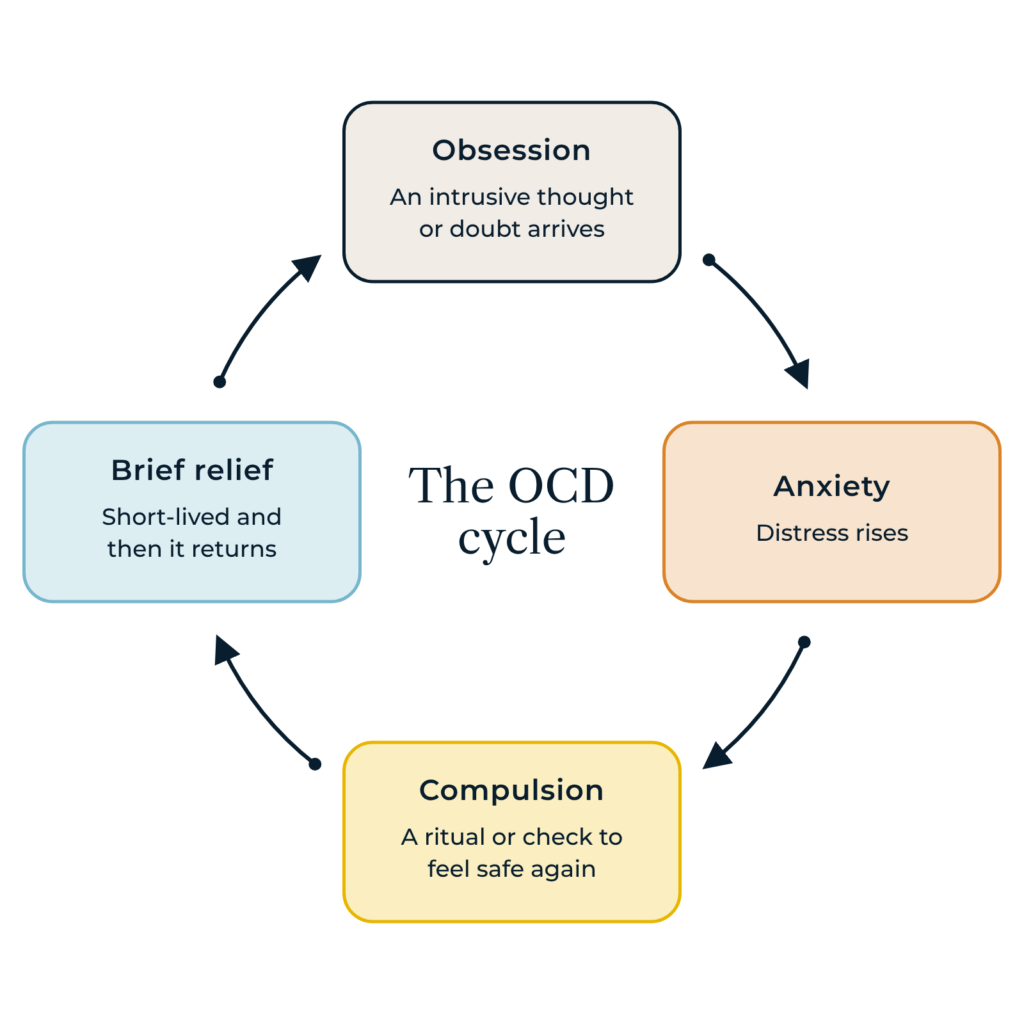
The cycle that keeps OCD going
Compulsions bring relief, but only briefly. They teach your brain that the obsession really was dangerous and that you are only OK because you did the compulsion. This keeps the cycle going.
What ERP actually involves
ERP stands for Exposure and Response Prevention. It is the gold-standard CBT approach for OCD. It's not about facing your worst fear all at once. It's a gradual, structured process with two connected parts.
Exposure
Deliberately, gradually facing the thoughts, situations, or sensations that trigger your anxiety – starting with something manageable, not overwhelming. This is planned together, at your pace.
Response prevention
Choosing not to carry out the compulsion or ritual that usually follows – and instead allowing the anxiety and uncertainty to be there. Over time, this teaches your brain that you can cope, and that the feared outcome is less likely than OCD insists.
-
01
Understanding your OCD
We map out your specific obsessions, compulsions and avoidance patterns – no two people's OCD looks quite the same.
-
02
Building your hierarchy
Together we list the situations and thoughts you fear, from mildly to highly anxiety-provoking, so we always know where to start and how to progress.
-
03
Starting small, in session
We begin with a manageable exposure, with support in the room, and practise sitting with the discomfort without responding to it.
-
04
Practising between sessions
Agreed exercises between appointments help the learning stick – always something you've chosen and feel ready for.
-
05
Building on progress
As each step becomes easier, we move up the hierarchy, checking in regularly and adjusting the pace as needed.
Common Myths: What OCD Isn't!
OCD is one of the most misunderstood conditions in mental health. Clearing up a few myths often makes it easier to recognise, and to ask for help.
Myth
OCD is just about being neat, tidy or liking things clean.
Reality
Cleanliness is only one of many possible themes. OCD can centre on harm, relationships, morality, sexuality, symmetry or many other things that have nothing to do with tidiness.
Myth
Everyone's a little bit OCD.
Reality
Liking things a certain way isn't OCD. OCD is a recognised mental health condition that causes real distress and can take up hours of someone's day. Using it casually can make it harder for people to recognise it – or to seek help.
Myth
If someone knows their fear is unrealistic, they should just be able to stop.
Reality
Most people with OCD know, logically, that their fear is unlikely. Insight doesn't switch off the anxiety – the urge to complete the compulsion "just in case" often overrides logic entirely.
Myth
Compulsions are always visible actions, like washing or checking.
Reality
Many compulsions happen entirely in the mind – silently reviewing, mentally "checking" or repeating a phrase until it feels right. These can be just as exhausting, and just as treatable.
Myth
Having an intrusive thought means some part of you wants it to happen.
Reality
Intrusive thoughts are extremely common – most people have them. What defines OCD is the distress the thought causes and the compulsion that follows, not the content of the thought itself.
Myth
Treatment means being thrown into your worst fear straight away.
Reality
Effective treatment is gradual and collaborative. You and your therapist build a plan together, and you always have a say in the pace.
Common Questions

Who you'd be working with
BABCP Accredited Cognitive Behavioural Therapist
I'm Lauren Coombs, a BABCP-accredited expert in Cognitive Behavioural Therapy based in Wilmslow, Cheshire. I’m also a Senior Lecturer in Psychology at the University of Chester where I teach and supervise future therapists.
I work with adults managing anxiety and depression, many of whom have been quietly struggling for a long time before they reach out. I won't offer vague reassurance or ask you to simply think more positively. My approach is practical, structured, and paced around your life - because I work with a lot of people who can't put everything else on hold.
I offer face-to-face sessions in Wilmslow and online sessions for clients across the UK. Sessions are available on Mondays, Tuesdays and Thursdays including early mornings and evenings.
What I specialise in
I offer expert CBT for a range of recognised problems. Many of my clients arrive with a diagnosis. Many don't, and that's fine too. What matters is your experience, not the label.
OCD
Not just checking and cleaning. OCD is driven by intrusive thoughts and the exhausting rituals that temporarily quiet them.
Panic Attacks
A sudden rush of physical symptoms and overwhelming fear that something awful will happen to you. Panic attacks are terrifying and often happen completely out of the blue.
Health Anxiety
A preoccupation with illness that isn't settled by reassurance from doctors, Google or the people around you. Checking brings brief relief, then the cycle begins again.
Social Anxiety
A fear of doing or saying something embarrassing and being judged by others. Left unaddressed, social anxiety can shrink your world.
PTSD
A condition that develops after experiencing or witnessing something deeply distressing. Memories of the event or the way it made you feel keep coming back to you.
Phobias
Fears of specific things like heights, animals, blood and needles. Phobias cause significant distress and change how you live.